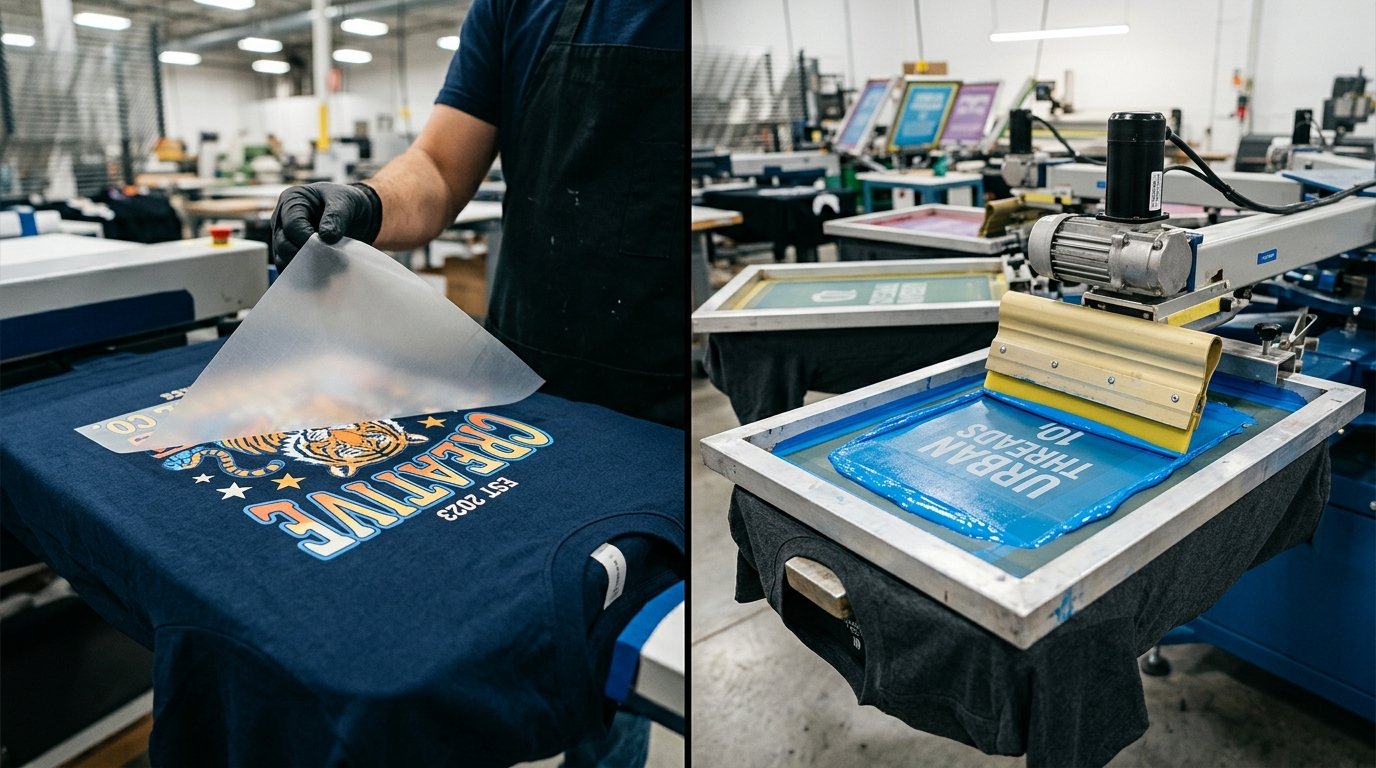

When customizing t-shirts and polo shirts for corporate branding or retail apparel lines, choosing the right printing technique determines whether your logo looks crisp and vibrant after 50 washes or cracks, fades, and peels within a month.
With technological breakthroughs in Direct-to-Film (DTF) printing transforming apparel production in Tirupur, many buyers wonder if traditional screen printing has become obsolete, or when premium techniques like High-Density (HD) 3D Rubber Printing are worth the investment. At Polos Inc, our print workshops house automated screen-printing carousels, 8-color DTF industrial printers, and silicone embossing presses. Below is your comprehensive technical and cost comparison.
Overview: How Each Custom Printing Technique Works
- Direct-to-Film (DTF) Printing: Water-based pigment inks are digitally sprayed onto a PET carrier film, coated with thermo-adhesive polyurethane powder, oven-cured, and transferred onto garments using industrial pneumatic heat presses at 160°C. Delivers photographic resolution with zero screen setup charges.
- Traditional Screen Printing (Plastisol / Water-Based): Stencils (screens) are burned for each color. Inks are squeegeed through mesh directly into the fabric weave, followed by conveyor dryer heat-curing at 170°C. Remains the global gold standard for large-volume wholesale orders.
- High-Density (HD) Rubber Print: Specialized high-viscosity silicone or plastisol ink applied through extra-thick capillary film screens (typically 200 to 500 microns). Creates razor-sharp, raised 3D geometric letters with tactile rubberized borders.
Comparison Matrix: DTF vs Screen Printing vs High-Density (HD)
| Comparison Parameter | Direct-to-Film (DTF) | Traditional Screen Printing | High-Density (HD) 3D Print |
|---|---|---|---|
| Color Capability | Unlimited photographic colors & smooth gradients | Spot colors (1 to 8 distinct pantone shades) | Solid spot colors (1 to 3 colors) |
| Hand Feel (Touch) | Thin, flexible film feel | Soft (water-based) to medium (plastisol) | Prominent raised 3D rubber texture |
| Wash Durability | 40 – 50 home washes | 60+ washes (exceptional) | 50+ washes (durable if cured properly) |
| Breathability | Moderate (blocks airflow over printed area) | High with water-based discharge inks | Zero airflow over raised surface |
| Setup Cost & Screens | Zero setup cost / No screens required | Screen burning fee per color layer | Specialized thick-film screen setup fee |
| Optimal Minimum Order | Small to Medium (50 – 300 pieces) | High Volume (300 to 10,000+ pieces) | Mid to High Volume (200+ pieces) |
| Unit Cost Scaling | Linear cost per sq inch (constant) | Drops significantly at 500+ units | Premium surcharge for multi-pass runs |
For embroidery comparison, also read our Screen Printing vs Embroidery Guide.
When Should You Choose DTF (Direct-to-Film)?
DTF is the superior choice under these specific conditions:
- Complex, Multi-Color Logos: When your company logo or client artwork has 6+ colors, drop shadows, or fine photorealistic gradients that would require astronomical screen setup charges.
- Fast Turnaround & Lower MOQs: Because there are no physical screens to coat, expose, and wash out, orders of 100–200 shirts can be printed and dispatched in 3–5 days.
- Challenging Fabric Blends: DTF bonds flawlessly to 100% polyester dri-fit, poly-cotton blends, and nylon windbreakers without dye migration issues.
When Should You Choose Traditional Screen Printing?
Despite digital advancements, screen printing remains unbeatable for:
- High-Volume Uniform Runs (300 to 10,000+ pcs): Once screens are made, printing speed is lightning fast, making cost-per-unit substantially cheaper than any digital method.
- Large Chest or Back Prints: Giant A3/A4 artwork in DTF uses a lot of ink film, driving costs up. Screen printing large graphics with soft-feel water-based inks is far more economical and breathable.
- Strict Pantone Color Matching: Screen inks are physically mixed by our master colorists to hit 100% exact Pantone matching system (PMS) standards.
When Should You Choose High-Density (HD) Rubber Print?
High-Density 3D printing is designed for visual impact and tactile luxury:
- Streetwear Fashion Collections: Bold typographic branding across the chest with a sharp, sculptural 1mm-to-2mm raised architectural profile.
- Premium Athleisure & Club Uniforms: Gives sports teams and gym brands a technical, high-performance aesthetic similar to Nike and Under Armour apparel.
Need Guidance on the Best Print Technique for Your Logo?
Send your vector logo (AI, EPS, PDF, or PNG) to our technical production team. We will analyze your artwork and recommend the most cost-effective, durable printing or embroidery solution.
💬 Send Logo for Free Print Analysis on WhatsApp (+91 98433 50000)
Or explore our Bulk Wholesale T-Shirt Services.