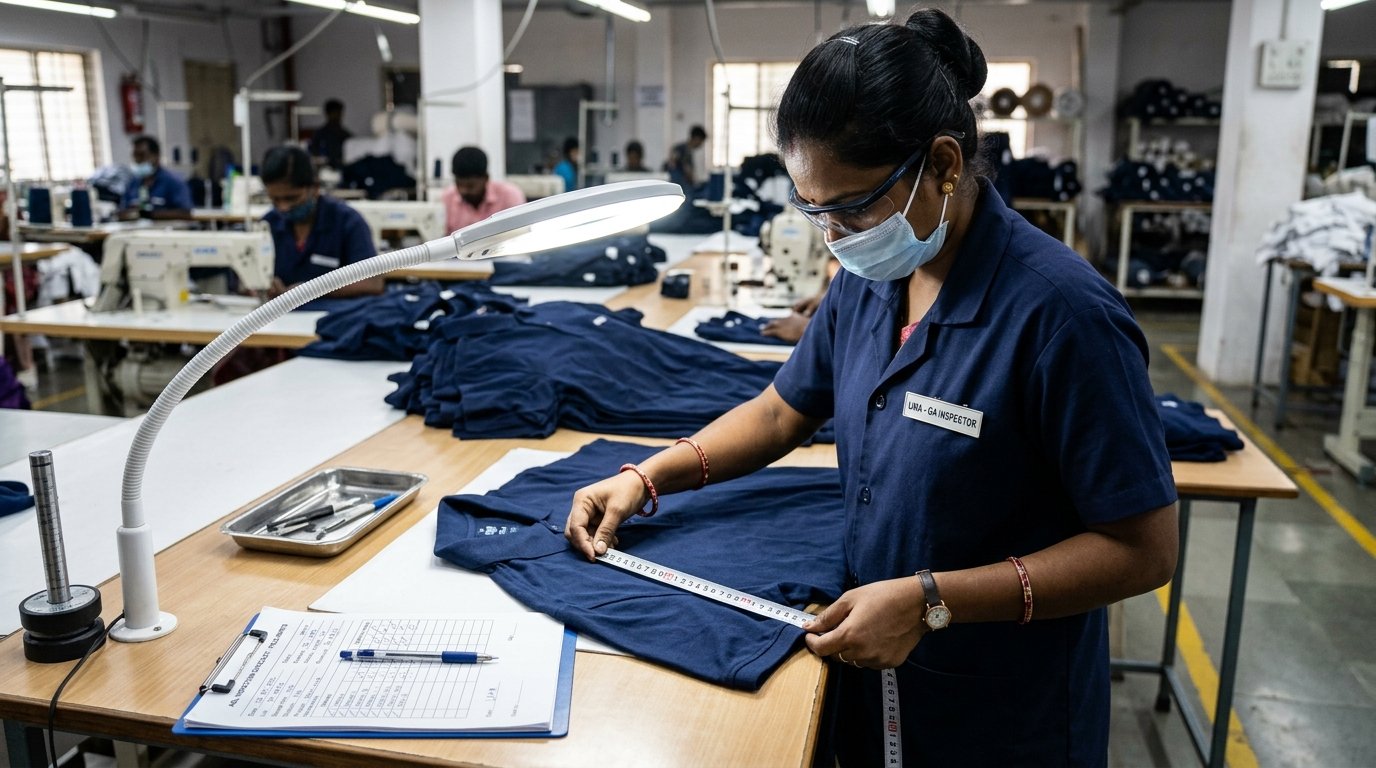

For fashion brands, corporate merchandise buyers, and export houses, quality assurance is the difference between customer praise and catastrophic product recalls. A garment that looks spectacular on the factory mannequin can quickly ruin brand reputation if 5% of the shipment arrives with skipped stitches, twisted side seams, or broken needle fragments lodged inside fabric folds.
At Polos Inc in Tirupur, we operate under rigorous international quality management systems compliant with ISO 9001 and ISO 14001. Below, our Quality Assurance (QA) directors pull back the curtain on how elite apparel mills execute garment quality control in Tirupur, from raw yarn testing to final container loading inspections under AQL 2.5 standards.
The 4 Stages of Factory Quality Assurance
Top-tier textile manufacturing relies on preventive, multi-stage quality gates rather than simply inspecting finished garments at the packing table:
“`
[Stage 1: Raw Material & Fabric] ➔ [Stage 2: Cutting & Pre-Assembly] ➔ [Stage 3: Inline Stitching & Branding] ➔ [Stage 4: End-of-Line & AQL 2.5 Audit]
“`
Stage 1: Raw Fabric Inspection (The 4-Point System)
Before any fabric roll is brought to the cutting tables, 10% of the knitted batch is randomly mounted onto illuminated inspection rolling machines operating under ASTM D5430 (The Standard 4-Point Fabric Inspection System). Penalty points are assigned according to defect lengths:
- Defects up to 3 inches: 1 point
- Defects between 3 and 6 inches: 2 points
- Defects between 6 and 9 inches: 3 points
- Defects over 9 inches: 4 points
Any fabric roll accumulating more than 40 penalty points per 100 square yards is immediately rejected and returned to the dyehouse.
Stage 2: Fabric Relaxation, Shrinkage & Color Shading Tests
Knitted circular fabrics experience high tension during knitting and dyeing. To prevent severe post-cut shrinkage and torque (spirality):
- Fabric Relaxation: Unrolled knit rolls rest flat on tensionless racks for 24 hours prior to cutting.
- Dimensional Stability Test: Fabric swatches undergo 3 standard wash-and-dry cycles according to AATCC 135 standards. Total shrinkage must remain strictly within ± 3.5% lengthwise and widthwise.
- Spectrophotometer Color Shading: Automated Datacolor spectrophotometers measure shade variation (Delta E < 0.8) across roll ends to prevent two-tone sleeves.
Stage 3: Inline Stitching & Needle Detection Protocols
During sewing machine line assembly, roaming QA supervisors audit operators at 60-minute intervals:
- Stitches Per Inch (SPI): Standard t-shirts and polos maintain 10 to 12 SPI for maximum seam strength and stretch recovery.
- Tension & Puckering: Ensuring 4-thread overlock and twin-needle hems stretch without breaking threads under tension.
- Strict Needle Breakage Protocol: If a sewing needle breaks, all fragments must be retrieved and mounted onto a needle record log before a replacement needle is issued. Every completed garment passes through a conveyorized 9-point metal needle detector to ensure absolute safety.
Understanding AQL 2.5: The International Inspection Standard
AQL (Acceptable Quality Limit) is the statistical sampling standard (ANSI/ASQ Z1.4 / ISO 2859-1) recognized globally by export buyers. Rather than inspecting every single garment in a 5,000-piece order, an internationally recognized statistical sample is drawn at random:
| Order Batch Quantity | Sample Inspection Size (Level II) | Critical Defects Allowed | Major Defects Allowed (AQL 2.5) | Minor Defects Allowed (AQL 4.0) |
|---|---|---|---|---|
| 151 – 280 pcs | 32 pieces | 0 (Fail if 1 found) | 2 | 3 |
| 281 – 500 pcs | 50 pieces | 0 (Fail if 1 found) | 3 | 5 |
| 501 – 1,200 pcs | 80 pieces | 0 (Fail if 1 found) | 5 | 7 |
| 1,201 – 3,200 pcs | 125 pieces | 0 (Fail if 1 found) | 7 | 10 |
| 3,201 – 10,000 pcs | 200 pieces | 0 (Fail if 1 found) | 10 | 14 |
Classification of Defects in Apparel Quality Audits:
- Critical Defect: Poses a safety risk or renders the garment completely unsellable (e.g., sharp broken needle tip, torn fabric hole, incorrect safety warning label). Acceptance: Strictly 0.
- Major Defect: Obvious visual flaw that impacts aesthetics or durability (e.g., crooked front placket, open seam stitch, severe color stain, chest width out of tolerance by > 1 inch). Acceptance: AQL 2.5 limit.
- Minor Defect: Minor cosmetic imperfection easily remedied (e.g., untrimmed loose thread > 5mm, slight removable dust smudge). Acceptance: AQL 4.0 limit.
Measurement Tolerances for T-Shirts & Polos
Knitted cotton is an elastic organic material. Acceptable industry tolerances include:
- Body Length: ± 0.5 inches (± 1.2 cm)
- Chest Width: ± 0.5 inches (± 1.2 cm)
- Shoulder Width: ± 0.25 inches (± 0.6 cm)
- Collar Width / Height: ± 0.125 inches (± 0.3 cm)
Work with a Factory That Never Compromises on Quality
Eliminate apparel sourcing anxiety. Every bulk production run at Polos Inc is backed by our in-house 4-point fabric audits, needle safety detection, and comprehensive AQL 2.5 inspection reports.
💬 Connect with Quality Control Desk (+91 98433 50000)
Or review our Tirupur Sourcing Guide.